Section B, Part 3: TECHNIQUE
When tacking up, make sure that the cavesson is as tight as
possible, so that it will not slip round and injure the horse’s face. Clip the
lunge rein on to the centre ring, and sort out the loops in your hand. (Remember
to drop the rein on the ground AWAY from your horse’s feet) Wrap the thong of
the whip around the stick section, so that it does not drag on the ground and
scare your horse while leading it to the lungeing area, and tuck the whip under
your arm, away from the horse, so that it cannot be trodden on.
Walk the horse in a small circle in the direction you wish it to go first,
then stop and face the horse’s side. Place the spare loops of the lunge rein and
the whip in the hand nearest the horse’s quarters, the hand nearest the head
holding the rein as you would while riding.
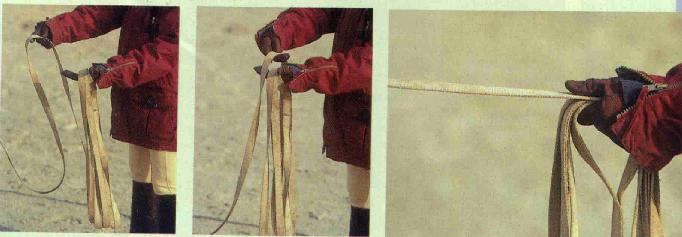 handling the lunge line correctly
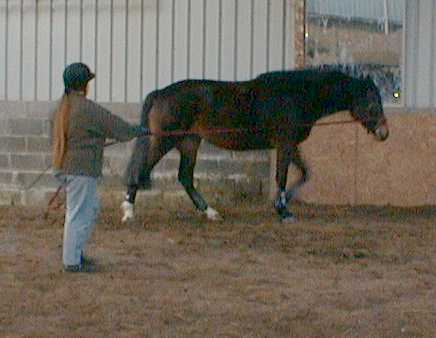
Briskly ask the horse to "walk on", but do not step away from it, let the
horse walk away from you, taking the rein out of your hands with it. Bring the
whip around to point at the horse’s shoulder to ask it to go out on the circle.
You want the horse to go on as big a circle as possible, to minimise the risk of
muscle strain and "brushing" (the legs banging into each other.) Stay out of the
way of the hindlegs when first pushing the horse out onto a larger circle, to
avoid unexpected kicks.
 Walk the horse on in a good march – not a plod. If the horse trots away, let
it, it will soon calm down. If it has a little buck, rear, or bolt, just hold
on, stand your ground, give firm half-halts on the rein, and wait for the little
episode to subside, and carry on as normal. Do not let the horse stop at any
time that you have not asked it to, as it may spin around. Do not be afraid to
use the whip to touch the horse if it does not seem to respect your commands,
but do NOT crack the whip, or lash the horse with it.
The whip can be either "passive" – held with the point on the ground, or
"active" – with the point being held level with the horse’s body. At the
shoulder the whip encourages the horse to move out on the circle, and at the
quarters, it encourages the horse to move forwards. If the horse is really
bothered by the whip, then allow it to move behind you, or tuck it under your
arm, and use your arm, or the spare loops of rein waved at the horse for the
action of a whip.
Walk the horse on in a good march – not a plod. If the horse trots away, let
it, it will soon calm down. If it has a little buck, rear, or bolt, just hold
on, stand your ground, give firm half-halts on the rein, and wait for the little
episode to subside, and carry on as normal. Do not let the horse stop at any
time that you have not asked it to, as it may spin around. Do not be afraid to
use the whip to touch the horse if it does not seem to respect your commands,
but do NOT crack the whip, or lash the horse with it.
The whip can be either "passive" – held with the point on the ground, or
"active" – with the point being held level with the horse’s body. At the
shoulder the whip encourages the horse to move out on the circle, and at the
quarters, it encourages the horse to move forwards. If the horse is really
bothered by the whip, then allow it to move behind you, or tuck it under your
arm, and use your arm, or the spare loops of rein waved at the horse for the
action of a whip.
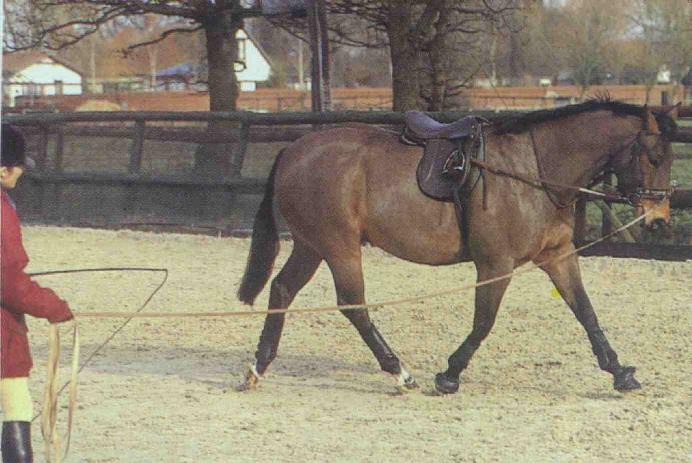
lungeing with an active whip |
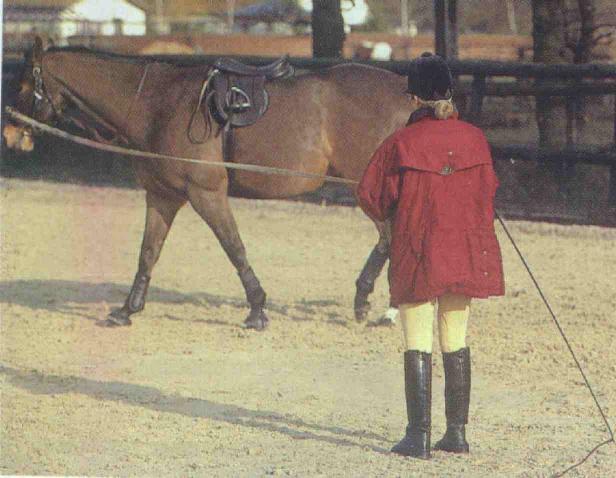
lungeing with a passive whip |
Asses the horse in walk and trot on one rein, seeing how it moves and how
attentive it is to you, then bring it forwards to walk again, and then halt.
Immediately walk towards it , tucking the whip under your arm so as not to spook
the horse, and taking in the rein as you go, and give it a pat for stopping and
standing still. If it will not stop, run it into a wall – very few horses carry
on when a wall is in their faces!
To change the rein, cut across the circle you have just been on, transfer the
whip and spare loops into the other hand, and lead the horse in a small circle
in the new direction, before stopping, then ask the horse to walk on away from
you. Asses the walk and trot on the new rein, and then set about improving it
through plenty of transitions, varying the size of the circle, running with the
horse along a long side of the school to extend the trot, using your voice and
the rein to steady the trot and collect it, and anything else which helps.
For exercise purposes, plenty of trotting is in order, making sure that the
horse is “tracking up” – i.e. that the hind feet are falling into the prints of
the fore feet. Continue on both reins until the horse is blowing slightly, and
the muscles are warm. The skin should be damp, but not lathered in sweat. Once
the horse is suitably exerted, cool down in walk while the horse’s nose is
almost touching the ground, stretching its back and neck, until it’s
respiration rate is back to normal.
Go back to the menu- Lungeing Methods
|
See also
Equicom News
Lungeing
Section A
1. Equipment
2. Technique
Section B
1. Equipment
2. Tacking Up
3. Technique
Section C
1. Long Reining
About the Author
|
