Section C, Part 1: LONG-REINING
The progress from lungeing to long-reining is fairly simple – you already
have the voice commands established, so all you really need to do is introduce a
second lunge line. Have one line attached to either bit ring, side D on a
headcollar, or side rings on a lungeing cavveson.
With a saddle, have the stirrups down, and tied together under the horse’s
belly with baling string, or other quick-release fixture, and run the two lines
through the stirrups to your hands. With a roller, run the lines through the
highest side rings, as close to your riding hands position as possible.
Begin by lungeing as normal on a circle, being careful to keep the line round
the horse’s backside off the floor and above his hocks. If he has a bit of a
kick around, be patient, and do your best to prevent him getting his legs caught
up in the line, although lessons in the stable beforehand passing ropes around
his backside to accustom him to the sensation should mean he is not bothered by
it. A handy hint is to have a long, soft bandage running from the saddle or
roller, from one side to the other when you are lungeing, so he gets used to the
feeling of it touching him as he moves.
You may find that the extra line does wonders for your horse’s impulsion and
encourage him to move forwards more. It is also useful for stopping him from
swinging his hindquarters out on a circle.
Gradually begin to step further behind your horse on the circle, until you
are well behind his backside, although still facing his side on the circle, not
his bum! (In normal lungeing you should be level with the horse’s shoulder) Once
he is happy with taking orders from you in this position, then begin to step in
behind him, closer to his hoof tracks, and to move with him. You will have to be
quite fit if you intend to lunge and long-rein him in trot for long!
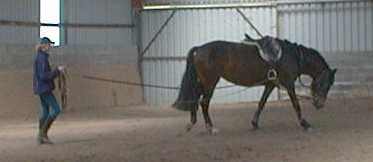
a youngster going well in long-reins.
In the following week of lessons, begin to shorten the lines and stand more
directly behind him, keeping about one horse’s distance between you and him, and
just out to one side so he can see you behind him, at least for the first two
weeks or so, as horses DO have a blind spot directly behind their tails, and
have to move their head slightly to one side to see there, which you do not want
when asking for straightness!
It can be quite awkward at first coordinating two lines and a whip, so
practise on the ground first (lines clipped onto a door or wall-rings etc…) to
get the hang of reeling in two lines quickly and so on, and definitley practise
with an older more experienced and patient horse first, before attempting to
teach your own – it is not as easy as it looks!
Go back to the menu - Lungeing Methods
|
See also
Equicom News
Lungeing
Section A
1. Equipment
2. Technique
Section B
1. Equipment
2. Tacking Up
3. Technique
Section C
1. Long Reining
About the Author
|
